
Every mobile groomer hears some version of the same question from a curious neighbor: “How do people even find you?” It’s a fair question, because it’s the one that decides whether your business grows or stalls. A grooming van gives you the lowest overhead and the most flexible schedule in the industry — but it also means you don’t have four walls and a storefront sign doing marketing for you 24/7. You have to build that visibility yourself.
The good news: mobile groomers have real advantages once they know how to use them. You’re hyper-local, which search engines reward. You generate visual, shareable content every single day. And your van itself is a rolling billboard that traditional salons can’t match. This guide walks through the full marketing stack — from the fundamentals to AI tools that can save you hours a week — so you can go from “best-kept secret” to booked out.
What’s in this guide
- Start with a brand people recognize from the curb
- Own your local search results
- Build a website that converts, not just exists
- Content and social proof that build trust
- Paid ads and local partnerships
- Put AI to work in your marketing
- Turn the van itself into a marketing asset
- Track what’s actually working
- Mistakes worth avoiding
- FAQs
1. Start With a Brand People Recognize From the Curb
Before a single ad dollar gets spent, your brand needs to be consistent everywhere a client might see it: the van wrap, your Facebook page, your business cards, your invoices, even your grooming smock. Inconsistent branding is one of the fastest ways to look like a side hustle instead of a professional business — and pet owners are trusting you with a family member.
At minimum, lock down a logo, a color palette, and a tone of voice, then use them everywhere. If you haven’t nailed this down yet, we’ve written detailed guides on both:
- 5 Simple Tips for Designing a Logo for Your Grooming Van
- 5 Easy Tips for Creating Your Mobile Grooming Brand
Quick win: Take five minutes and check your business name, phone number, and hours on your Google Business Profile, Facebook Page, Instagram bio, and website. If any of them don’t match exactly, fix it today — inconsistent listings quietly hurt your local search ranking.
2. Own Your Local Search Results
This is the section most new owners skip — and the one with the biggest return. When someone searches “mobile dog groomer near me,” they’re not scrolling to page two. Local SEO determines whether you show up in that first screen of results, and for a mobile business, it matters more than almost anything else you’ll do.
Set up your Google Business Profile as a service-area business
Because you don’t operate from a storefront, your Google Business Profile should be configured as a service-area business rather than a physical location. This tells Google to show you for searches across the towns and zip codes you actually serve, instead of just the one address where you park the van overnight. Google’s official setup instructions walk through this step by step: Google Business Profile: Service-Area Business Setup.
Build service-area pages, not just a single homepage
If you serve multiple towns, a single page trying to rank for all of them will struggle to rank for any of them. Instead, create a short, genuinely useful page for each major service area — “Mobile Dog Grooming in [Town]” — with your service list, starting prices or price range, and a few local landmarks or neighborhoods you cover. This is one of the highest-leverage SEO moves a mobile business can make, because it matches exactly how people search.
Why this matters more for mobile groomers than storefronts
A traditional salon competes for one location. A mobile groomer can legitimately rank in five, ten, even fifteen towns — if the content and Business Profile setup support it. That’s a structural advantage over brick-and-mortar competitors that most new owners never take full advantage of.
3. Build a Website That Converts, Not Just Exists
Most pet owners will find you on a phone, often while standing in their driveway wondering if a mobile groomer is even a real option. Your website’s job in that moment is simple: answer “do you come to me, what does it cost, and how do I book” in under ten seconds.
- Lead with your service area. “Now booking in [Town, Town, Town]” above the fold beats a generic hero image every time.
- Show pricing transparency. Even a “starting at” range builds trust and filters out mismatched leads before they call.
- Make booking effortless. A visible phone number, text-to-book option, or online scheduler — not a contact form buried three clicks deep.
- Add a before-and-after gallery. This is the single most persuasive content type in the grooming industry.
- Optimize for mobile first. Test your own site on your phone in direct sunlight — that’s the real-world condition it needs to perform in.
Curious what the ROI actually looks like once the marketing engine is running? Our Mobile Grooming Profit Calculator and 2026 ROI & Startup Blueprint are useful benchmarks to sanity-check your growth targets against.
4. Content and Social Proof That Build Trust
Grooming is one of the most visual services on earth — use that. Every appointment produces content: the transformation, the happy client text, the dog falling asleep in the tub. Treat that as inventory, not an afterthought.
Before & after posts
Your highest-performing content type, every time. Post consistently, tag the breed, and keep a saved highlight reel on Instagram.
Short video
A 15-second clip of a nervous pup relaxing mid-groom builds more trust than any paragraph of copy could.
Client testimonials
Screenshot real texts (with permission) and rotate them into stories — unpolished feels more trustworthy than a script.
Referral program
Offer a small credit for referrals from happy clients. Word of mouth converts at a far higher rate than cold ads.
Gallery
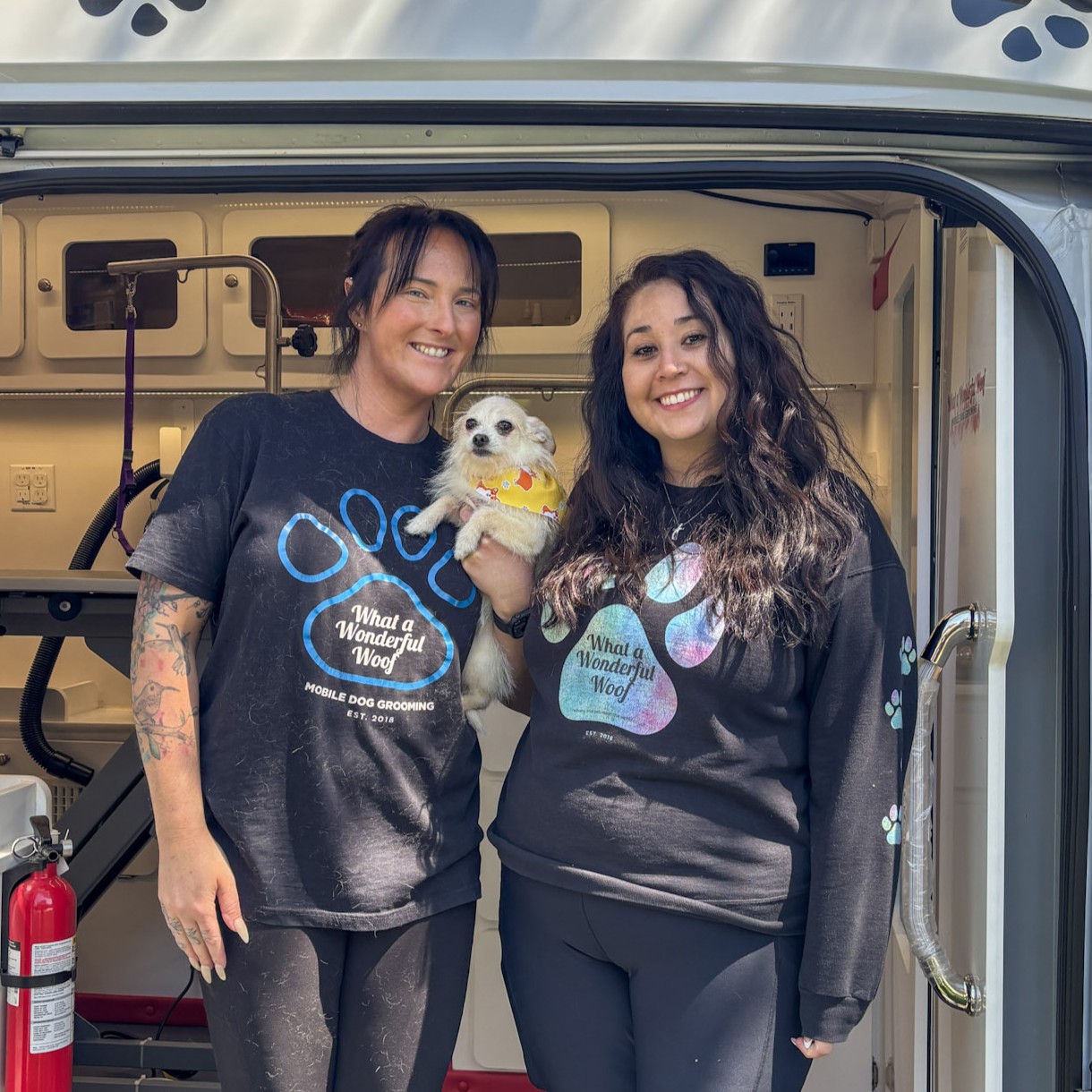
Swap the tiles below for real photos: your van in different neighborhoods, a groomer at work, a before-and-after pair, and a happy client with their pet.



5. Paid Ads and Local Partnerships
Organic content and local SEO should be the foundation, but paid channels can accelerate growth once your booking process can handle the volume.
- Hyper-local social ads. Meta ads targeted by a tight radius around your service area outperform broad targeting — mobile groomers don’t need reach, they need proximity.
- Google Local Services Ads. Pay-per-lead ads that appear above traditional search results, with a “Google Guaranteed” badge that builds instant trust for a service happening inside someone’s home or driveway.
- Nextdoor. Because it’s organized by neighborhood, it’s one of the highest-converting platforms for home-based services like mobile grooming.
- Veterinary referral partnerships. Vets are asked “do you know a good mobile groomer” constantly. A simple cross-referral relationship with a local clinic can become a steady lead source. We go deeper on this in The Benefits of Referrals Between Mobile Pet Groomers and Veterinarians.
6. Put AI to Work in Your Marketing
This is the part every owner asks about now, and for good reason: AI tools won’t groom a single dog, but they can absolutely take marketing tasks off your plate — the ones that pile up at the end of a long day on the road. Used well, AI is a time-multiplier for a solo or small-team operation. Used carelessly, it produces generic content that sounds like everyone else’s. The goal is to let AI handle the first draft and the busywork, while you keep the final say on voice and accuracy.
Here are concrete ways mobile groomers are using AI tools like Claude or ChatGPT today, along with example prompts you can copy, adapt, and paste in.
1. Turning one appointment into a week of social captions
2. Drafting review responses in your voice
3. Building local service-area page copy
4. Testing ad copy variations fast
5. Planning a month of content in one sitting
The guardrail that matters most: never let AI invent pricing, availability, medical claims about pet health, or client details you haven’t provided. Use it to draft and organize — always fact-check and add the real specifics yourself before anything goes live.
Want a deeper walkthrough of AI use cases specifically built for mobile groomers, including scheduling and customer service? Read our full guide: How to Use AI to Transform Your Mobile Grooming Business.
7. Turn the Van Itself Into a Marketing Asset
Your van is parked in a different driveway or neighborhood every day — that’s free impressions traditional businesses pay for. Make sure it’s earning its keep:
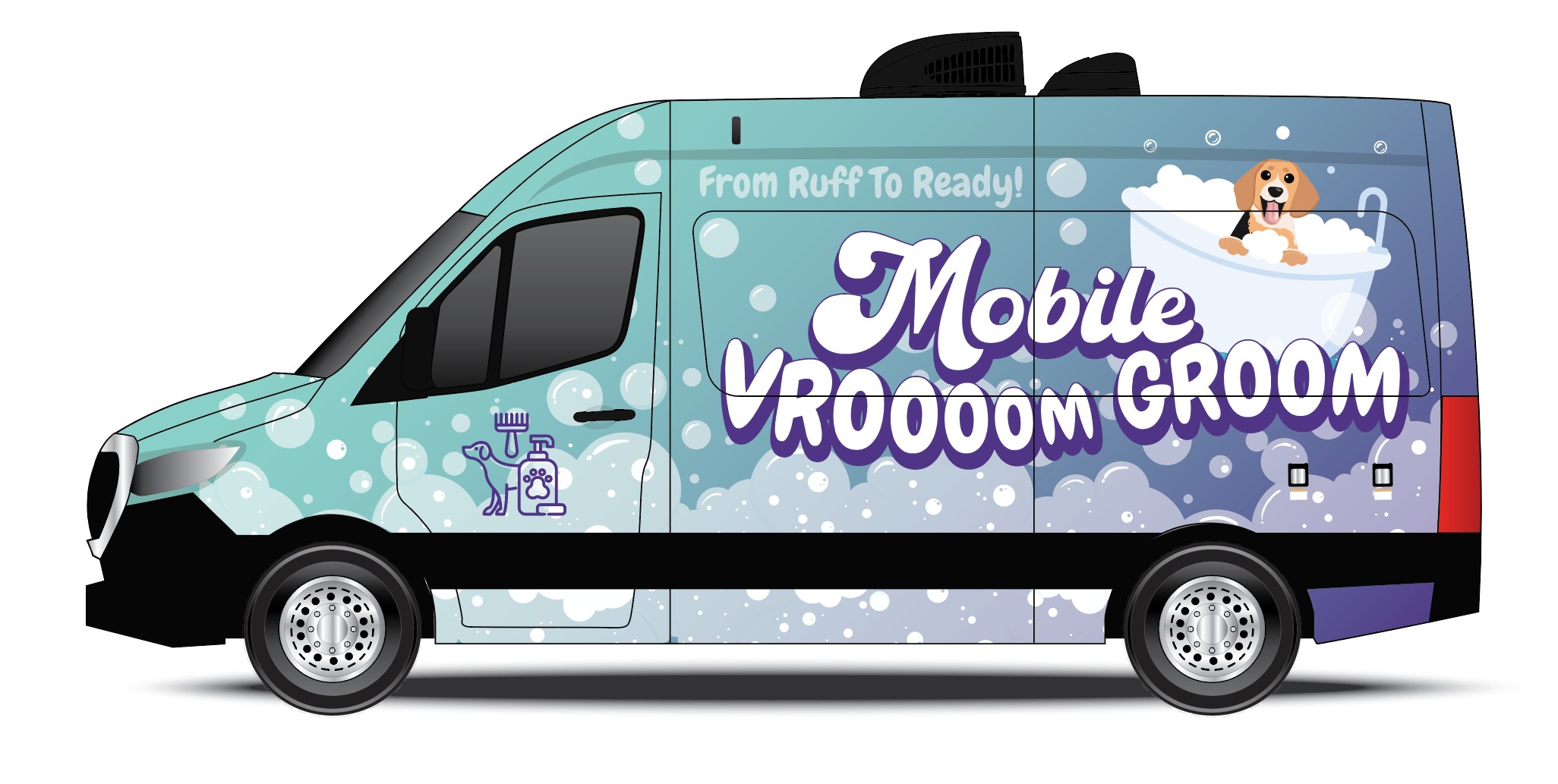
- Invest in a full wrap, not just a decal. A bold, branded wrap is legible from a moving car and gets remembered.
- Include your phone number and one clear call to action — “Book Online” plus a short URL is easier to remember than a long web address.
- Park with intent when it’s safe and permitted — a visible spot near a dog park or pet store entrance (with permission) extends your reach beyond the appointment itself.
- Keep it clean. A pristine, professional-looking van is itself a trust signal before you ever ring the doorbell.
For more ideas on making your van stand out, see Decorate Your Wag’n Tails Groom Van.
8. Track What’s Actually Working
Marketing without measurement is just guessing with extra steps. You don’t need enterprise software to know what’s paying off — a simple habit will do:
Once you see a pattern — say, Nextdoor consistently outperforming Facebook ads — you can shift budget and time toward what’s actually filling the calendar instead of what feels productive.
9. Mistakes Worth Avoiding
Marketing missteps are common in the first year, and most are fixable once you know what to look for — inconsistent posting, no clear service area, underpricing to compete on cost alone, and skipping reviews are among the most common. We break these down in detail in Biggest Mistakes Mobile Groomers Make, alongside Is a Mobile Dog Grooming Business Profitable? if you’re still weighing the numbers.
It’s also worth staying connected to the wider grooming community — organizations like the National Dog Groomers Association of America offer education, certification, and networking that can indirectly strengthen your marketing, since credentials and community involvement are trust signals pet owners notice.
Frequently Asked Questions
How do I market a mobile grooming business with no budget?
Start with the free, high-leverage moves: a fully optimized Google Business Profile, consistent before-and-after posts, and asking every client for a review. These cost time, not money, and they compound over the first few months.
Is local SEO really different for mobile groomers vs. a salon?
Yes. Your Google Business Profile should be set up as a service-area business rather than a fixed storefront, and you have the advantage of being able to rank across multiple towns instead of just one location.
What’s the best AI tool for a mobile groomer’s marketing?
General-purpose AI assistants (like Claude or ChatGPT) work well for drafting captions, review responses, ad copy, and content calendars. The tool matters less than the habit of using it consistently and always fact-checking specifics before posting.
How often should I post on social media as a mobile groomer?
Three posts a week is a realistic, sustainable baseline for most owners — consistency matters more than volume. A before/after, a tip or behind-the-scenes moment, and a client spotlight covers the essentials.
Ready to build your route?
A great marketing plan needs a van that can back it up. Talk to our team about vehicles, financing, and the support that comes standard with every Wag’n Tails build.